
Lunar Calendar: August 2026
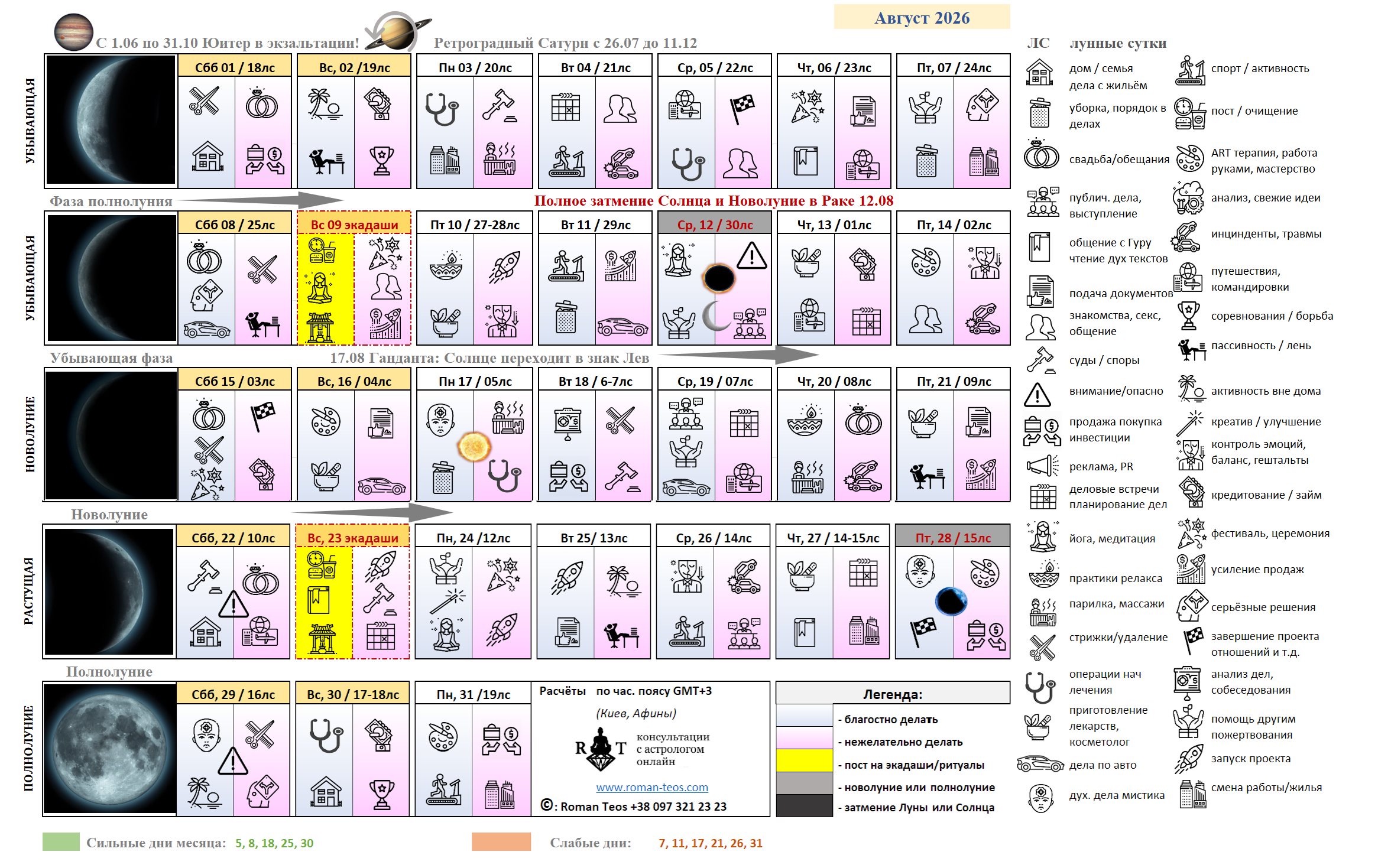
If you’d like to align your plans with the lunar cycles, the Lunar Calendar for August 2026 is a practical guide to help you make the most of the month. It includes the Moon’s phases, favorable dates, and helpful daily recommendations for every day of August.
- August Ekadashis and a special fast for the family
- Total Solar Eclipse — August 12
- Partial Lunar Eclipse — August 28
The word “calendar” comes from the Latin calendarium, meaning “account book” or “register of interest.”
Since Roman times, we’ve moved from taxes and debts to the grid hanging on our wall:
- Kalends (Kalendae): in the ancient Roman calendar, the kalends was the first day of each month.
- Bill payment: traditionally, this was the day monthly debts fell due, accounts were settled, and interest accrued.
- The book: the book used to track these debts and payments was therefore called a calendarium.
Over time, the word’s meaning shifted: instead of a book tracking payments due on certain days, it came to mean the system used to track the days themselves. So although a calendar today is no longer about “tax collection time,” its literal linguistic ancestor was quite definitely a debt-collection tool!
Weak days of August, or “empty hands”
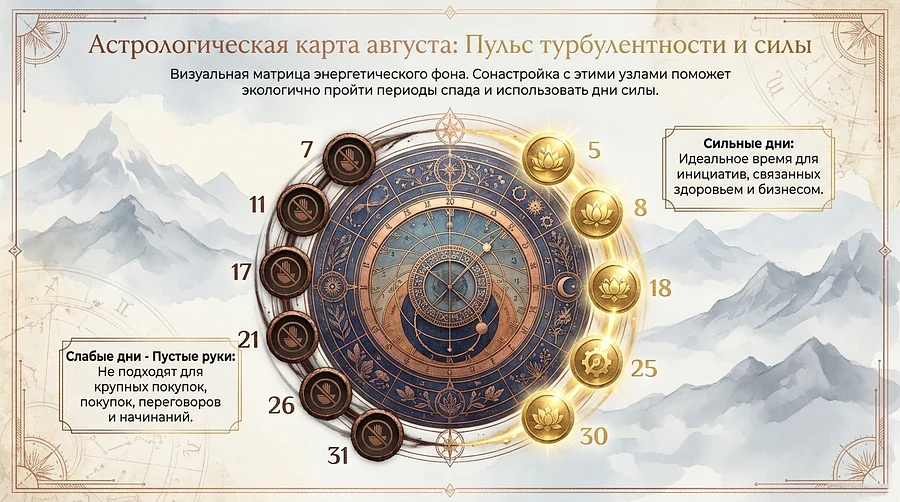
These days aren’t suited for starting important projects, making major purchases, or entering serious negotiations: 7, 11, 17, 21, 26, 31.
Power days of August 2026
5, 8, 18, 25, 30 — these days favor new beginnings connected with both health and business. August carries blessed energies, and attuning correctly to the lunar rhythms will help unlock our inner potential.
August 9 — Kamika Ekadashi
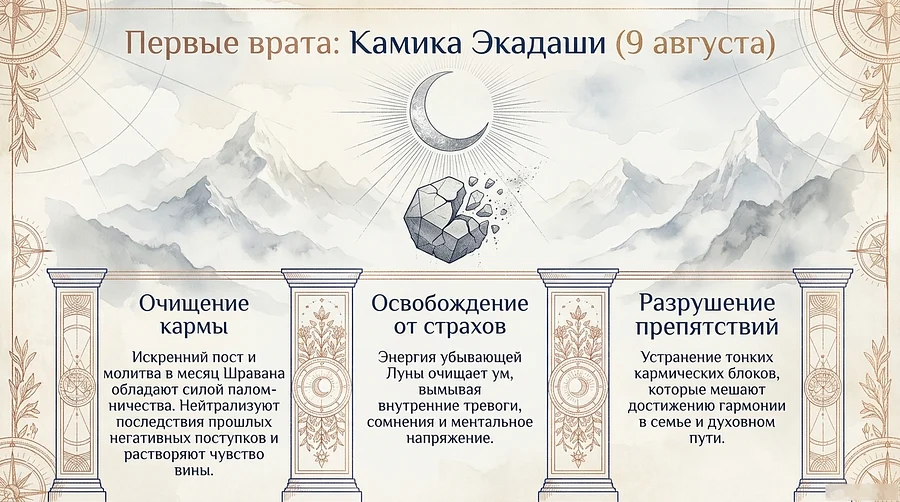
This day falls during the waning Moon (Krishna Paksha) of the month of Shravan. Kamika Ekadashi holds a remarkable purifying power and grants blessings equal to a pilgrimage.
Key features and meanings:
- Karmic purification: sincere fasting and prayer on this day are believed to neutralize the consequences of past negative actions (sins) and release feelings of guilt.
- Freedom from fear: the day’s energy helps overcome inner anxieties and doubts, bringing peace to the mind.
Total Solar Eclipse — August 12

In the Jyotish tradition, this eclipse occurs in the sign of Cancer, in the most enigmatic and mystical of all nakshatras — Ashlesha (symbolized by intertwined serpents, ruled by the Nagas, divine serpents of wisdom and hidden power). On the physical and energetic planes, Ashlesha governs the nervous system, the intestines, the lymph, and hidden poisons and toxins, both physical and mental.
When the eclipse temporarily “switches off” the Sun — our main source of life force, Prana, and digestive fire, Agni — the body can shift into a state of turbulence.
Sutak, the most sensitive window, runs until 8:30 PM Kyiv time.
Effects on the physical body
Because Ashlesha is directly linked to serpent energy (Kundalini, poisons, regeneration) and Cancer’s watery element, the eclipse may trigger the following symptoms:
- Lymphatic “waterlogging” and swelling: Cancer’s watery nature tends to retain fluid under the eclipse’s influence. Expect possible heaviness in the body and morning puffiness.
- Digestive disruption (weakened Agni): Ashlesha projects onto the intestines and the manipura area. During the eclipse, digestive fire drops nearly to zero. Any heavy food turns into Ama (toxins), causing bloating, heaviness, and intoxication.
- Nervous system oversensitivity: Ashlesha is ruled by Mercury. Expect a surge of sensory overload — irritability from loud sounds, background anxiety, insomnia, or, conversely, a “squeezed lemon” state of exhaustion.
- Activation of hidden inflammation: the eclipse energy in Ashlesha acts as a catalyst, bringing everything that was hidden up from the depths, including chronic, low-grade processes in the body.
Aromatherapy: containing Ashlesha’s serpent venom
An eclipse in Ashlesha calls for oils that ground the body, draw out toxins, and calm an overactive nervous system, all at once.
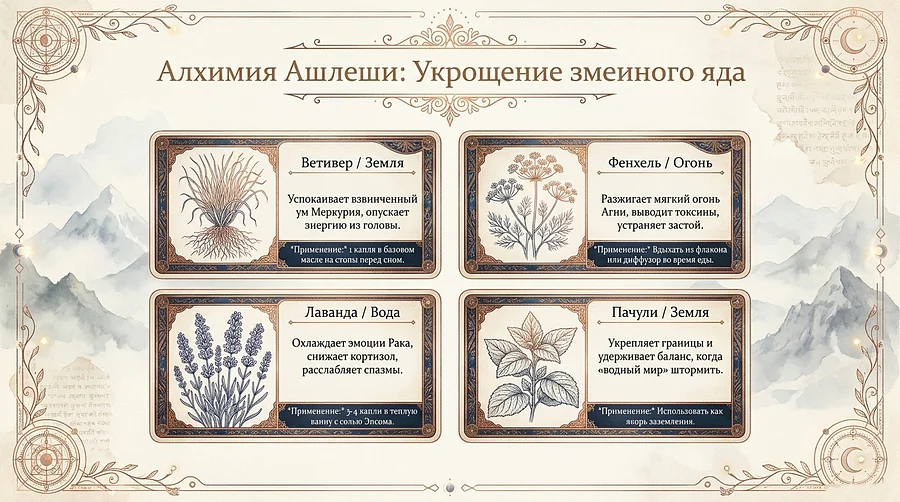
| Oil | Effect on the body and subtle energies | How to use |
|---|---|---|
| Vetiver | A deeply grounding oil. Calms Mercury’s overwrought mind, brings excess mental energy down from the head into the body, and eases anxiety. | Apply 1 drop, diluted in a carrier oil (almond, sesame), to the soles of the feet before bed. |
| Fennel | Directly supports the digestive system, kindles a gentle digestive fire, helps eliminate toxins, and counters stagnation. | Inhale from the bottle or use in a diffuser during meals. |
| Lavender | Cools Cancer’s overheated emotions, lowers cortisol levels, gently relaxes tense muscles, and prepares the body for sleep. | Mist the room an hour before bed, or add 3-4 drops to a warm bath with Epsom salt. |
| Patchouli | Connected to the element of Earth. Helps maintain balance when Cancer’s “watery world” starts to storm under the eclipse. Strengthens boundaries. | Apply 1–2 drops, diluted in a carrier oil, to the solar plexus area or the soles of the feet. |
If you’d like oils chosen not just for the eclipse but for your own chart and emotional state, there’s a dedicated Aroma Diagnostics program that selects essential oils personally for you.
- Removing obstacles: fasting clears subtle mental and karmic blocks that stand in the way of family harmony.
The Sun’s transit into Leo and August’s Gandanta
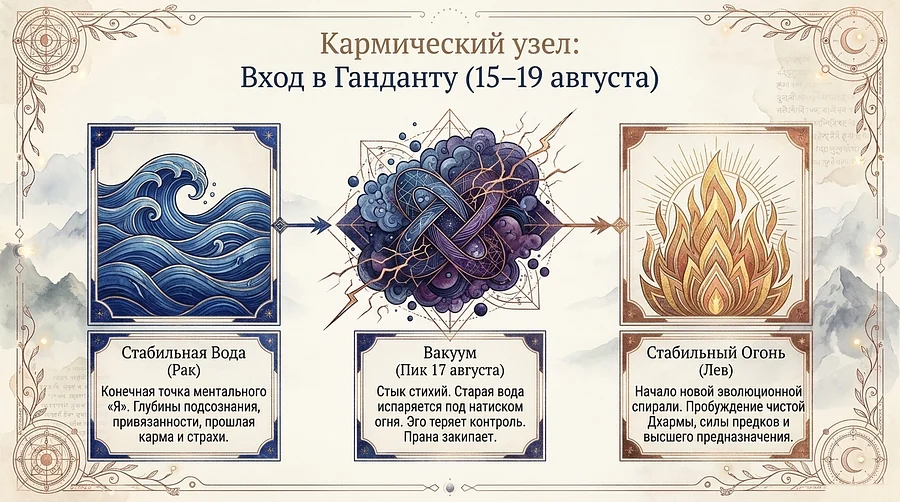
Gandanta (from Sanskrit, “karmic knot” or “spiritual dead end”) is the junction between a water sign and a fire sign. As the Sun moves from Cancer (Ashlesha nakshatra) into Leo (Magha nakshatra), one of the year’s most powerful energetic ruptures takes place. On August 17, 2026, the Sun will cross this invisible threshold.
Let me walk you through how this “knot” bends and reshapes the flow of our life force (Prana), and how to move through this zone of turbulence in a healthy way.
The psycho-energetic meaning of the transit:
This junction is called the Ashlesha-Magha Gandanta.
- Ashlesha (Cancer, Water): represents the depths of the subconscious, attachments, past karma, fears, and the mind’s poisons. It’s the endpoint in the development of the mental “I.”
- Magha (Leo, Fire): the beginning of a new evolutionary spiral. Here, pure dharma awakens, along with the power of the ancestors (Pitris), the creative fire of spirit, and awareness of one’s higher purpose.
The essence of Gandanta: the pranic flow “boils over” in these days, quite literally. Cancer’s stale, stagnant water evaporates under the rising fire of Leo. Energy at the junction of the signs loses its stability — this is the moment when the old supports have already collapsed and the new ones haven’t yet appeared. Our ego loses its usual control, opening access to the soul’s deeper prana.
How does the flow of pranic power change?
As the Sun passes through Gandanta (roughly August 15–19, peaking on August 17), the flow of prana undergoes sharp fluctuations:
[Stable Water (Cancer)] ➔ [Boiling Junction (Gandanta)] ➔ [Stable Fire (Leo)]
(Emotion, attachment) (Pranic chaos, vacuum) (Clarity, will, dharma)
- The “vacuum” effect and depletion: the Sun governs our immunity (Ojas) and our will. At the Gandanta point, its energy seems to “sink” into the karmic knot. You may feel sudden apathy, a loss of direction, and confusion: “Where am I going, and why?”
- Emotions coming to a boil: Water and Fire produce steam. Prana begins to circulate chaotically through the subtle channels (Nadis). This can show up as sudden flares of anger giving way to unexplained sadness or anxiety.
- Weakened physical vitality: the cardiovascular system and the solar plexus (the Sun’s zone of projection) become vulnerable. Watch for blood pressure spikes, arrhythmia, and a feeling of heaviness in the chest.
August 23 — Shravana Putrada Ekadashi
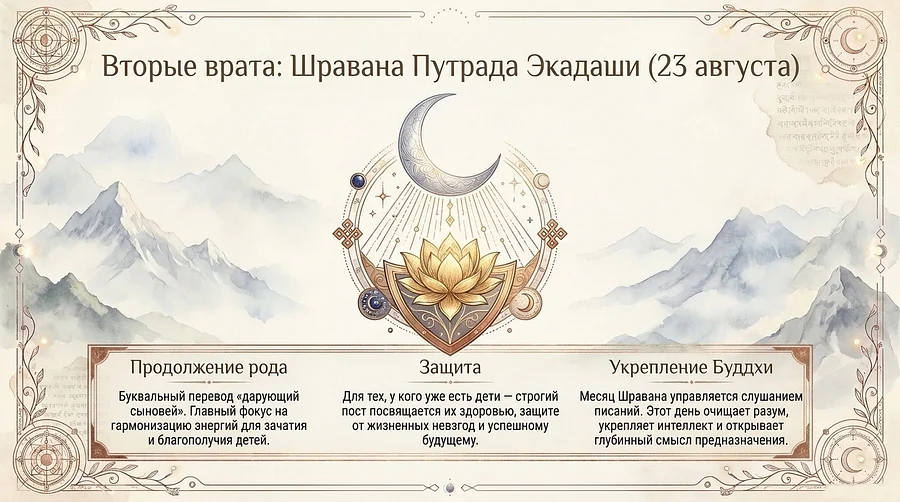
This day is observed during the waxing Moon (Shukla Paksha) in the sacred month of Shravan. The word “Putrada” literally translates as “the one who grants sons (offspring).”
Key features and meanings:
- A blessing for continuing the family line: this day’s central focus is harmonizing the energies for conception, childbirth, and children’s wellbeing. Couples hoping for children observe this fast with particular strictness.
- Protection and prosperity for children: for those who already have children, this fast is dedicated to their health, spiritual growth, protection from life’s hardships, and a successful future.
- Clearing the mind: since the month of Shravan is ruled by the energies of learning and listening to sacred scripture, this Ekadashi strengthens the intellect (Buddhi) and helps you understand your purpose more deeply.
Lunar Eclipse — August 28
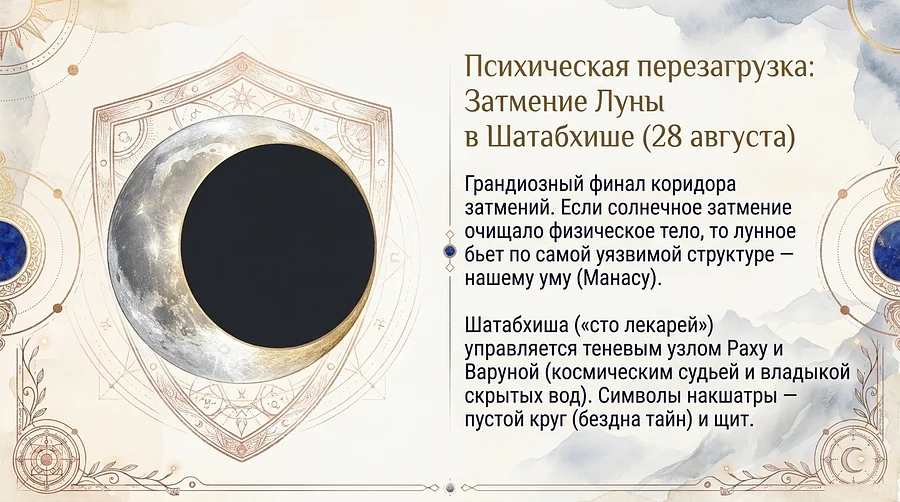
The lunar eclipse on August 28, in the nakshatra Shatabhisha (sign of Aquarius), is the grand finale of this eclipse corridor. If the solar eclipse in Ashlesha (August 12) reset our physical settings and purified the body, the lunar eclipse strikes the subtlest, most sensitive, and most vulnerable structure of all — our mind (Manas) and our psyche.
Shatabhisha translates as “a hundred physicians” or “a hundred healing stars.” Its symbols are an empty circle (representing the void, cosmos, and mysteries) and a shield. This nakshatra is ruled by the shadow node Rahu, and its presiding deity is Varuna, the cosmic judge, lord of the waters, of hidden depths, and of karmic debts.
What the psyche should prepare for: the main effects
A lunar eclipse temporarily “dims” our emotions, intuition, and sense of safety. Under Rahu’s rule in Shatabhisha, this effect scales up to cosmic proportions:
- The “opened reservoir” effect (meeting the shadow)
Shatabhisha holds onto hidden, suppressed emotions that we’ve kept hidden for years behind a “shield” of mental control and social masks. During the eclipse, that shield drops. Old fears, unrecognized anxiety, blocked grief, or suppressed anger may come flooding out. The psyche may encounter a feeling of existential loneliness.
- Mental chaos and illusion (Rahu’s influence)
Rahu is the master of illusion (Maya). In Shatabhisha, it can push the mind toward paranoid thoughts, excessive suspicion, or obsessive ideas. Inner conflicts may intensify — a sense of being “one of us among strangers, and a stranger among one’s own.” The psyche may struggle to distinguish intuitive insight from mental noise and fear.
- A crisis of “psychological isolation”
Shatabhisha is a closed-off, introverted nakshatra, prone to secrecy and solitude. During the eclipse, you may feel an overwhelming urge to “hide in a cave,” cut off all contact, and shut the world out. Interacting with people may feel unbearably draining.
- Catharsis and a point of healing
Because Shatabhisha is the nakshatra of healers, this crisis carries a sacred quality. The psyche moves through a phase of “the old ego’s death” in order to heal. This is the moment when, through emotional pain and crisis, comes the long-awaited release from the mental patterns that have been poisoning your life for years.
Psychological biohacking: how to protect and heal the mind
The period from August 26 to 30 will ask you for the utmost awareness and the role of “impartial observer.”
The practice of “disidentification”:
When a wave of fear, anxiety, or sadness rises up, don’t get swept into it. Take a deep exhale and silently tell yourself: “I am not these emotions. I am the one who observes them.” Let these states simply flow through you, like water through a sieve.
The “five-second rule” before reacting:
During these days, Rahu will provoke confrontations and hasty conclusions. If you feel the urge to say everything on your mind, pause first. Don’t make any decisions about relationships, work, or life while at the peak of emotion.
Gentle solitude instead of social bustle:
Plan for minimal social contact on August 27–29. Limit your news and social media intake — informational clutter acts like poison under Shatabhisha. Better to spend time alone, journal your feelings, draw, or listen to relaxing music.
The element of Water — your main therapist:
Since Shatabhisha’s presiding deity is Varuna, lord of the waters, water becomes your medicine. Take warm showers with the intention of washing away others’ energies and mental grime. Drink plenty of clean, warm water.
Aromatic support for the subtle body
To stabilize the mind in Rahu and Shatabhisha’s embrace, we need scents that clear the consciousness, ground us, and build a psycho-emotional shield:
- Sandalwood: the greatest cooler of the mind in the Vedic tradition. It instantly calms an overexcited Rahu-ruled Manas (mind), reducing mental heat, anger, and anxiety. Apply a drop to the “third eye” area (between the brows) for mental stillness.
- Frankincense: an oil of high vibration and spiritual protection. Frankincense literally “seals” breaches in the aura and subtle body, helps you cope with the fear of loneliness, and connects you to higher guidance. Excellent for meditation during eclipse days.
- Cypress or Juniper: scents that clear space and the psycho-emotional field of foreign energies and stagnant emotions. They help ease the process of letting go of the old.
Varalakshmi Vrat falls on August 28, 2026

A “Lakshmi sadhana” for material wellbeing.
This is one of the most significant days for receiving the blessing of the goddess Vara-Lakshmi (Lakshmi in her form as the mistress of the household hearth), patroness of prosperity, youth, and beauty. The prefix “Vara” in her name translates as “golden.”
On this day, it’s recommended to practice “Lakshmi sadhana” to strengthen the wellbeing of every family member.
I’ll walk through the detailed technique of the “Lakshmi sadhana” in the club’s Telegram channel.
Worshipping the divine mother in the form of Lakshmi brings harmony to family relationships and restores lost understanding, love, and trust.
By the way, both of August’s eclipses — solar and lunar — have their own detailed ritual in the course “Vedic Rituals Throughout the Year”: step-by-step practices timed to these exact dates, to help you move through the eclipse corridor more gently and consciously.
You can download the calendar for free via the link in the description.
Related Posts
Lunar calendar: November 2025
Favorable days of November Retrograde transits of Jupiter and Mercury Venus in full force…

Saturn Transit 2026 for Aquarians
Hello, dear Aquarians! I am concluding a series of articles on the influence…

The altar in the house is a sacred place in space
Dear friends! Over the past few months, there have been no leaves from one…