
Who is Shiva according to Vedic tradition
Millions of people repeat these words every day. Yet few pause to consider their depth. “Om Namah Shivaya” is just five syllables. Still, it holds an entire map of existence. So, who is Shiva, really? Is he simply one god among many in the Hindu pantheon? A character from ancient myth? Or is he something closer to us than we first assume? Let’s find out together. We’ll lean on original texts like the Shiva Purana and Shiva Samhita, sources that tantric practitioners and yogis have studied for a thousand years.
In this article:
- What the mantra “Om Namah Shivaya” means, syllable by syllable
- Three faces of Shiva: Nirguna Brahman, Saguna Shiva, and Adiyogi
- The destroyer who doesn’t kill: what Shiva means for us today
- Sawan 2026: the sacred month dedicated to Shiva
- How to practice these traditions if you don’t live in India
What the Mantra “Om Namah Shivaya” Really Means
Let’s start with the sound itself. “Om Namah Shivaya” is a Panchakshara mantra, meaning a five-syllable mantra, not counting the original sound “Om.” The Shiva Purana, along with various tantric texts, explains that the five syllables, Na, Ma, Shi, Va, and Ya, form a sacred code of the universe. Together, they encode the five elements, or panchamahabhuta, that make up both the physical world and our own body.
| Syllable | Element | What It Activates Within |
| NA | Earth (Prithvi) — Muladhara | Grounds consciousness, brings stability, clears chaos, and nourishes the physical form |
| MA | Water (Jala) — Svadhishthana | Softens the mind, releases emotional tension, and restores flexibility |
| SHI | Fire (Agni) — Manipura | Burns away illusion and ego, and brings clarity along with inner drive (tapas) |
| VA | Air (Vayu) — Anahata | Sets prana in motion, and brings lightness, freedom, and compassion |
| YA | Ether (Akasha) — Vishuddha and above | Opens consciousness beyond the body, leading to the state of the pure Witness (Sakshi) |
The syllable “Namah” translates to “not mine.” In other words, it’s a conscious release of the ego’s grip on creation, a bow to something greater than ourselves. So, as you chant the mantra syllable by syllable, you move through a journey. You travel from dense earth all the way to the pure space of spirit, from “Na” to “Ya,” returning the mind to its original home: pure consciousness, Shiva within. This isn’t a request made to an external god. Rather, it’s an act of recognizing yourself.
Three Faces of Shiva According to the Shiva Purana and Shiva Samhita
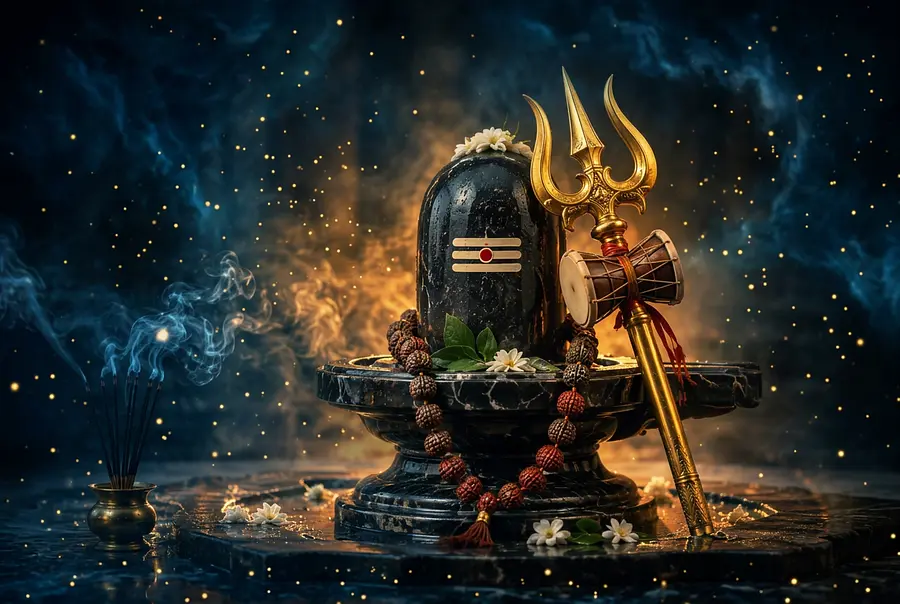
Both ancient texts describe Shiva as far more than a character in a pantheon. Instead, they present him as the essence of ultimate reality, unfolding across three distinct levels.
Nirguna Brahman: the Formless Absolute
The first level is Nirguna Brahman, the Absolute without form or attributes. In this primordial state, Shiva is Parashiva: pure, undivided, infinite consciousness (Chit). He exists beyond time, space, matter, and the three gunas, the basic qualities of nature. He isn’t “someone.” Rather, he is the very space of being from which everything arises, and into which everything eventually dissolves. In fact, the name “Shiva” itself literally means “that which is not,” not as an absence, but as the boundless ground behind every form.
Saguna Shiva: the Birth of the Manifest World
The second level is Saguna Shiva, the source of the manifest world. Out of primordial silence, a dynamic aspect emerges: Shakti, the energy of creation and nature itself. Through the union of Shiva and Shakti, the entire visible cosmos is born. Here, Shiva becomes Mahadeva, the “great god” who expresses three forms of one cosmic rhythm. Brahma creates, Vishnu sustains, and Rudra, or Shiva, transforms and dissolves, returning everything to its Source.
Adiyogi: the First Teacher on the Inward Path
Finally, the third level appears in the Shiva Samhita: the path of yoga. Here, Shiva is Adi Guru, Adiyogi, the original teacher and the first yogi. He is the pure witnessing consciousness, or Sakshi, living inside every being as the atman, the soul. The placement of the chakras, the movement of the breath (prana), and the awakening of kundalini all describe one journey: the return of the individual mind back to the pure Absolute, back to Shiva within.
The Destroyer Who Doesn’t Kill: What Shiva Means for Us Today
Our era is defined by a hyperactive mind, an overload of information, a culture of consumption, and constant anxiety about the future. Against this backdrop, Shiva’s imagery takes on real, practical significance.
Destruction as cleansing, not annihilation. Shiva’s destroyer aspect means dissolving illusions (avidya), false attachments, and the shapes that hold us back. Before something new can form, in the psyche, in a career, or in life itself, the old and false must be allowed to dissolve.
Stillness at the eye of the storm. Shiva is depicted meditating on Mount Kailash, undisturbed by any storm, cosmic or otherwise. He represents our true self: not the stream of thoughts, not stress, but the quiet witness behind it all.
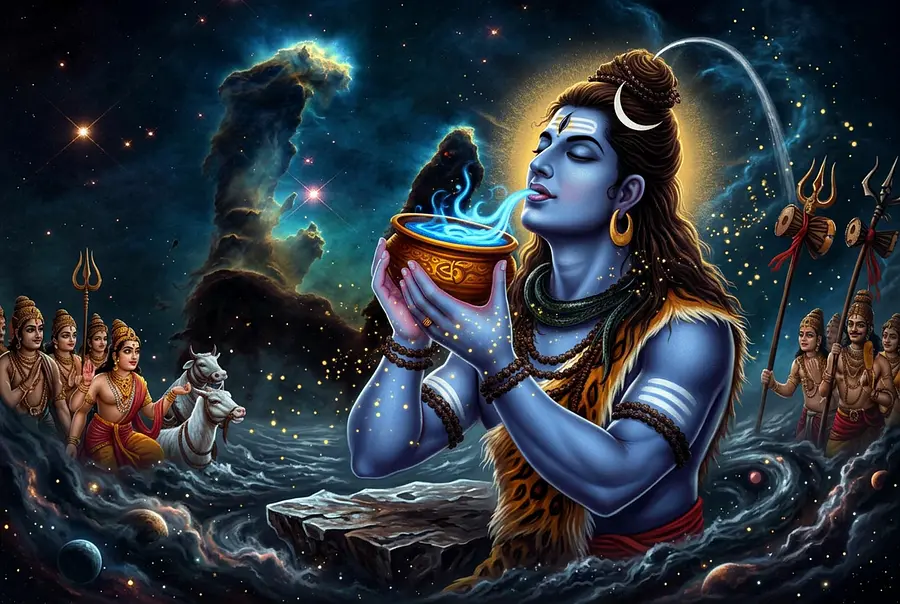
The poison that became maturity. According to legend, the churning of the cosmic ocean released a deadly poison, halahala, capable of destroying the entire universe. Shiva drank it and held it in his throat, which is why he’s depicted with a blue neck and carries the name Nilakantha. Today, this symbolizes emotional and spiritual maturity: the ability to transform incoming negativity and the world’s pain within yourself, rather than lashing out or being destroyed by it.
Simplicity without masks. Shiva is called Bholenath, the innocent one, and Pashupati, lord of all beings. He welcomes gods and mortals alike. He sits half-naked, covered only in ash (bhasma), free from social masks. This reminds us that a person’s true worth lies in clarity of consciousness, not in status or titles.
Dancing to life’s rhythm. Shiva’s dance, the tandava, performed as Nataraja, symbolizes dynamic balance. He dances upon Apasmara, the demon of ignorance and forgetfulness, showing us that life’s motion cannot be stopped. However, we can learn to move with its rhythm instead of letting routine dull our awareness.
The art of healthy detachment. Shiva’s ascetic image teaches vairagya, the practice of solitude and non-attachment: being in the world without becoming its slave.
Sawan 2026: The Sacred Month Dedicated to Shiva
Vedic tradition sets aside an entire month for Shiva: Sawan, also called Shravan Maas. According to the lunisolar calendar, it falls in July and August. In 2026, following the northern Purnimanta calendar, it runs from July 30 to August 28.
The month’s defining feature is Mondays, or Somvar. Since Monday is traditionally Shiva’s day, every Monday during Sawan is considered especially auspicious for fasting (vrata), mantra recitation, and rituals (abhisheka).
According to legend, this is the very month when the churning of the ocean took place, and Shiva drank the poison to save the world. To ease his suffering, the gods brought him pure water and milk. Ever since, devotees pour Ganges water or milk over the Shiva lingam throughout Sawan. Many also undertake a pilgrimage to Shiva’s temples known as Kanwar Yatra, in which millions of pilgrims, called Kanwariyas, carry water from sacred rivers on foot, dressed in saffron.
The recommended practices are simple: time for silence, chanting “Om Namah Shivaya” or the Maha Mrityunjaya mantra (the great mantra of immortality), light vegetarian food, avoiding alcohol, and making offerings on Mondays.
To dive deeper into the exact dates and rituals of Sawan, our blog has a full article dedicated to this month: “The Sacred Month of Purification, Shravana 2026”.
How to Practice These Traditions If You Don’t Live in India
At its core, Sawan is a time for deep purification and turning the mind inward, for taming our own inner “poisons,” following Shiva’s own example. The Vedas offer a helpful principle here: desha-kala-patra, meaning “place, time, and circumstance.” It allows practices to adapt without losing their essence.
| Classic Practice | Western Adaptation |
| Bel (bilva) leaves, a trefoil symbolizing the trident and the three gunas | Clean clover or wild strawberry trefoil leaves, an oak leaf, a silver trefoil charm, or white rice with turmeric (akshata) |
| Water from the Ganges | Clean spring or filtered water, blessed with a water-consecration mantra |
| Strict fasting | Light eating: no fast food, alcohol, onion, or garlic on Mondays; a focus on seasonal fruits and vegetables |
| A vow of silence at a temple (mona-vrata) | One to two hours of silence at home, no conversation, social media, or news |
| Ritual meditation at a shrine | 15 to 20 minutes of chanting “Om Namah Shivaya” or the Maha Mrityunjaya mantra, morning or evening |
Before the ritual, you can chant this water-consecration mantra over the water: “Om Gange cha Yamune chaiva Godavari Sarasvati, Narmade Sindhu Kaveri jalesmin sannidhim kuru,” an invocation calling the sacred energies of all pure rivers to be present in the water. You can also say it in your own words; what matters most is the purity of intention, not exact pronunciation.
The core principle here isn’t geography. Rather, it’s purity of intention. Any object that represents silence, purity, and calm in your own mind will work. That, ultimately, is Shiva’s energy, and it will start to emerge from within you.
If you’d like to move beyond reading about stillness, and actually experience it, our club offers a meditation course called “Inner Support” .
When you look closely, Shiva doesn’t ask anything extraordinary of us. He simply looks for the best quality in each of us, and overlooks the rest. Isn’t that real freedom? To be recognized not for status or achievement, but for the clarity of your own consciousness. This image is worth studying more deeply, and worth holding quietly in your heart. Perhaps, in doing so, you’ll become a little quieter, a little steadier, and a little more yourself.
Om Namah Shivaya
Related Posts
Lunar calendar: November 2025
Favorable days of November Retrograde transits of Jupiter and Mercury Venus in full force…
Saturn Transit 2026 for Aquarians
Hello, dear Aquarians! I am concluding a series of articles on the influence…
The altar in the house is a sacred place in space
Dear friends! Over the past few months, there have been no leaves from one…